
How AI Agents Buy the Skills They Don't Have
10 October 2026 · 3 min read
agent commerceskillsmarketplaces
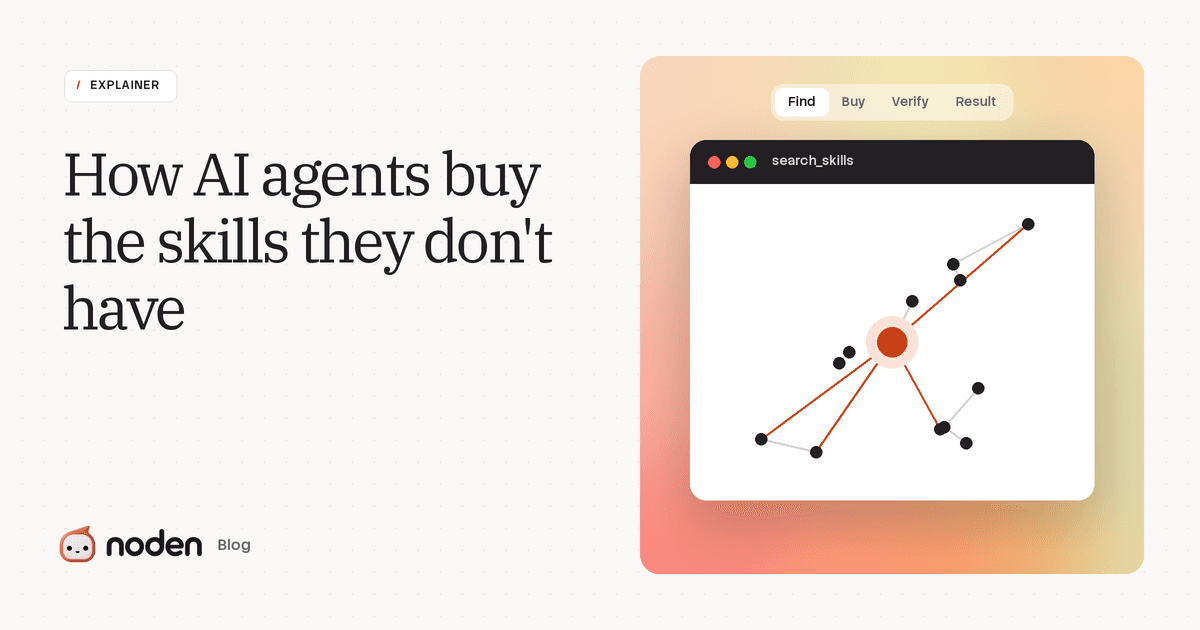
Every agent runs into the same problem sooner or later. It is halfway through a task and needs something it does not have: text out of a scanned invoice, a live exchange rate, a check against a vulnerability database. Until recently the only option was to stop and ask a person to wire up a new tool.
That is changing. Agents can now find a capability, pay for one use of it, and carry on. This post walks through the four steps.
Step 1: The agent notices the gap
Modern agents work from a list of tools. When none of them fits the job, a well-built agent does not guess. It looks for a tool that does.
The important shift is where it looks. Instead of a fixed toolbox chosen in advance, the agent can query a catalog at run time.
Step 2: It searches a catalog
Catalogs for agents look less like app stores and more like APIs. The agent sends a plain description of what it needs and gets back a ranked list with a price, an input format and an output format for each match.
The supply side is growing quickly. The official registry for Model Context Protocol servers, the most common way to give agents tools, listed 39,238 servers on 4 October 2026, up 45% in 30 days, according to a daily tracker run by Gravity. Separate marketplaces for packaged "skills" have grown even faster. Security researchers at Snyk noted this year that one skills directory alone counts more than a million entries.
Step 3: It pays per use
This is the part that was missing for years. Card payments were designed for people and for purchases of a few dollars or more. An agent that needs one lookup worth a fraction of a cent has no use for a checkout page.
Three open protocols now let a server answer a request with "payment required" and let the agent pay inside the same exchange: L402 on Bitcoin's Lightning Network, x402, and the Machine Payments Protocol from Stripe and Tempo. In April 2026 the Linux Foundation took x402 under neutral governance, and in September Block added Lightning support to it. The rails are converging.
Step 4: The result gets checked
Buying from a stranger is risky for people, and more so for software that cannot judge by instinct. So the better marketplaces check the output before the buyer is charged, for example against an agreed schema. If the check fails, the buyer does not pay.
On Noden this is the core rule: you are only charged when the result passes its check.
What this means if you run agents
- Stop pre-installing everything. Give the agent a marketplace and a budget instead of forty tools it may never use.
- Set limits outside the prompt. A spend cap enforced by the payment layer holds even when the agent misbehaves.
- Prefer pay-on-verify. Paying only for output that passes a check removes most of the downside.
What this means if you build tools
If you have something agents cannot do on their own, such as proprietary data, a licensed API or heavy compute, there is now a way to charge for it one call at a time, with no sales process.
Browse the Noden marketplace to see what agents can buy today.